
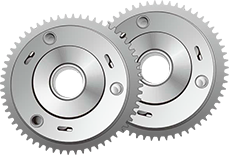
1. Drive belt;
If the engine roars when stepping on the accelerator and the vehicle speed cannot be increased, and there is power slipping; check the surface of the belt and it is found that there are cracks, fraying, elongation and deformation; during riding, there is abnormal friction noise from the transmission box when starting; when the vehicle is not moving and the power transmission is weak; it is very likely that the problem lies in the belt, and it is necessary to check and replace it if necessary.
Because the belt is the "link" for transmission, connecting the pulley and the drum, transmitting the engine power to the wheels. For the continuous variable transmission to work normally, the elasticity of the belt is indispensable. Without this elasticity, it is impossible to freely control the radius of the front and rear driving discs and use the friction force between the disc surface and the belt to transmit power. The material of the belt and the matching degree with the driving disc are also crucial. Only when they are well coordinated, will the belt not slip when power is increased and the power will not be wasted in vain.
2. Pulley;
If the vehicle has slow acceleration, lacks power on uphill, and fuel consumption increases; upon inspection, it is found that the pulley is worn and lighter, the centrifugal force is insufficient, and the gear shifting is not sensitive; the belt deviates and abnormally wears; the belt runs off track and abnormally wears; it is very likely that the pulley is worn unevenly. Then, it is necessary to replace the pulley. This is an irreparable problem.
Because the pulley is a counterweight block installed in the pulley disc, relying on centrifugal force to control the opening and closing of the pulley disc, adjusting the speed of gear shifting, and directly affecting acceleration and fuel consumption. The heavier the pulley, the stronger the pushing force brought by centrifugal force, and the belt is pushed outward on the pulley disc, resulting in a larger working radius.
That is, the heavier the pulley, under the same rotational speed, the higher the vehicle speed will be. Conversely, the lighter the pulley, it cannot open the pulley disc, the belt radius is small, and the vehicle speed under the same rotational speed will be lower.
At the same speed, using a heavier pulley will result in a lower engine speed, more fuel efficiency, and less noise, but the start-up and acceleration will be softer; using a lighter pulley, the start-up will be more powerful, and the acceleration will be faster, but the high-speed rotational speed will be higher, and the fuel consumption will be a little higher.
3. Pulley disc (driving wheel);
If deep grooves are worn on the surface of the pulley disc, the belt gets stuck and slips; the transmission box makes abnormal noise when accelerating, and the power is interrupted; the heat dissipation is poor, the disc surface gets hot, and the acceleration components age; it is very likely that the problem lies in the driving wheel.
Because the pulley disc is in coordination with the pulley jewel, changing the diameter of the belt through opening and closing to achieve continuous variable transmission. It is divided into the front pulley disc and the rear pulley disc, and it is mainly composed of the pulley disc, the pulley jewel, the pressure plate, and the maple leaf disc. The grooves on the pulley disc and the inclined surface on the pressure plate convert the outward centrifugal force of the pulley jewel into an axial force pushing the pulley disc forward.
Therefore, changing the shape of the grooves and inclined surfaces directly changes the transmission characteristics of the entire CVT.
4. Clutch release block;
When there is a violent jolt when starting, the jolt disappears after running; it is found that the release block is worn thinner, the surface is slippery, and it does not fit tightly; the release block spring breaks, and the power transmission is not smooth. It is very likely that the problem lies in the clutch release block.
Because the clutch release block is controlled by centrifugal force to combine or separate with the drum, controlling the cut-off and transmission of power, it is equivalent to an automatic clutch. The only adjustable component is the clutch spring and the clutch drum (drum jewel). The function of the small spring is to control the rotational speed of the clutch when it is combined. The clutch relies on the centrifugal force during rotation to overcome the tension of the small spring and push the蹄片 away to contact the clutch drum. During the entire transmission process, friction is very crucial: it needs to steadily transmit power and not slip or burn the disc under the high temperature generated by high-speed friction.
5. Drum (from the driven wheel);
When it is found that the inner wall is blue-burned, has scratches, and is uneven, there is a jolt when starting; there is abnormal noise generated by friction with the release block, and it is overheating; the belt debris accumulates in the drum, accelerating the wear of the components. This is obviously a problem with the drum.
Because: The drum mainly cooperates with the release block, receiving the power transmitted by the belt, and is the friction contact surface of the clutch. That is the "friction working surface" of the clutch, which is responsible for capturing the power, transmitting the power, and withstanding high temperatures without slipping. Without the bowl, the CVT transmission would lose its final link, and the power generated by the vehicle would not be able to be transmitted.